






As a continuation of my post from the other day, I thought I would try to provide examples of literature in translation—specifically genre lit in trans. Today we’re going to talk about Russia.
I was a big fan of Timur Bekmambetov‘s movies Night Watch and Day Watch from the moment I saw them. These were huge movies in Russia, making more money than the Lord of the Rings movies. If you haven’t seen them, they’re a visual feast of vampires, light vs. dark, guns, magic, car chases, and more. Even the subtitles are interesting.
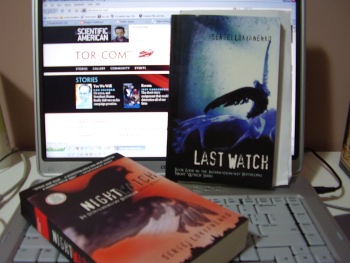
I knew at the time that they came from a series of books by Russian author Sergei Lukyuanenko. I picked up the first book and put it on my shelf to read (along with several hundred other books to read) when I received Last Watch in the mail from Miramax Books a few weeks ago.
I decided it was time to start reading. The first thing I can say is that I regret not starting sooner. But isn’t that always the case? Now I’m almost done with the first book, and I need to go pick up Day Watch and Twilight Watch before I can dig into Last Watch. The books are about a group called the Others, who are divided into Light and Dark. In the first book, we are concerned with the Night Watch, who are agents of the Light who watch things at night to make sure that the agents of the Dark are not breaking any rules.
The events are told through the eyes of Anton, a low-level mage for the Light. He’s tracking down some vampires, although it’s not clear initially that’s what he’s doing. Along the way, he encounters a young lady with a dark vortex over her head. You see, when you curse at someone, say they cut you off on the highway, that creates a vortex over their heads that makes them depressed, or have a migraine, or some other small malady. But these go away quickly. This young lady, however, has a vortex larger than anything Anton’s ever heard about. All the same, the young lady is not the task at hand for Anton, and as a young operative in the field, he can’t afford to dilly dally.
Of course, this large vortex becomes much more important than it initially seemed, as do the vampires that Anton is tracking. Anton screwed up with how he handled things, but he’s given another chance to fix them. He’s given a partner, who seems unstable, and has to try and solve his case while knowing less than everyone around him. Things are going to escalate quickly outside of Anton’s comfort zone.
While the basic set up is not ground-breaking in its originality, the voice that tells them is unique. Some of it is the fact that Lukyanenko comes from a vastly different background from me. Some of it is also that Russia/Asia is an unknown entity to me as well. But there’s also something in the way the Lukyanenko (and his translator) tell the story. You really get inside Anton’s head, and you really get a sense of how different it is in Russia from here in the States.
Plus, for those of you who have seen the movies, the books are different enough to make them worth reading. For me, this is a case where the look of the film matches the atmosphere of the book almost perfectly.

If you’re going to continue discussing genre literature in translation, can I put in a vote for Stanislaw Lem?
When I read Night Watch, I was really drawn in by how Anton desperately wants to do the right thing and yet always finds himself a pawn in the games of the powerful. And by his struggles to find the right thing to do in a world full of so much moral ambiguity. I imagine that there is something particularly about Lukyanenko’s experience in Russia that has allowed him to express those ideas so well, but I found a lot of personal resonance there too.
No doubt, you really get a sense from the books of how different Russia is from the US, but the reason that I liked it was that I could find much to relate to in Anton’s story.
I’ve long wanted to read these novels. (I haven’t seen the films either, just a few clips here and there.)
Now that the entire series seems to have already been made available in English translation, maybe I should start picking them up. Choosing which cover to get is only a minor obstacle.
I’m pleased to hear the translation worked well for you. That has been my primary worry.
Also, and this is something unsubstantiated since, like I said, I haven’t read the books, but someone told me that Lukyanenko’s books seem to be closer to collections of interlocking novellas rather than a novel in the “usual” sense of the term. Is there anything to that? It doesn’t matter to me either way; I’m just curious.
I just watched Daywatch yesterday, and have been meaning to read the novels for so long. When I looked up the status of the future movies, I was horrified to see (on Wikipedia, true) that Fox bought the rights and so Twilight Watch will probably be American. The first two movies match in style so perfectly, why break that?
I’ve read first three books long before the first film came out. And it was good enough. But the second one? Pretty meh if you’ve read the books first. It’s kinda alternative version in very short form, which is in my opinion is not so good.
But the books are great, although the Twilight Watch was a small disappointment for me, the Last Watch have recovered the series for me.
And by the way, the Last Watch is very ironic title for a book that wasn’t suppose to exist :-)
Oh, and on a second thought, I’d prefer another Russian author over Lukyanenko – Alexey Pekhov.
He’s writing a more standard fantasy, but it’s much more entertaining and have a much better story plots.
Just a quick note for anyone who has seen the movies but have not read the book (and yes that is book singular). The movie Night Watch is an adaptation of the first third of the book Night Watch. The movie Day Watch is a much looser adaptation of the rest of Night Watch. So far, Day Watch the book has not been adapted to screen.
@1 Lem is on the horizon!
@6 I’ll have to check out Pekhov, can you send some recommendations to editor[at]electricvelocipede[dot]com?
Anyone have any other suggestions of people to discuss for lit in trans, as far as genre’s concerned?
This trilogy makes excellent reading and I feel that there was special attention paid to the translation and keeping the spirit of the Russian viewpoint alive in them. Not to mention some of the little zinger-style stuff I caught in Last Watch, referring to how different the movie versions are from the books. I’ll say no more, however.
I agree that Stanislaw Lem’s work should also be raised, considering how well regarded his work is.
And @@@@@3. eldritch00 -> Its true that the books are somewhat interlocked novellas, but you really need to read them together in a row because there are major story elements that cross the ‘novella’ style chunks. Believe me, you’ll likely have no objection to the manner in which it was structured once you read and enjoy!
john_klima @@@@@ 8:
Another author you might consider is Andrzej Sapkowski, who wrote the Witcher novels, at least one of which has made it into English translation.
I’m still of split opinion about it, but its the only one I can think of off the top of my head with a little google-fu.